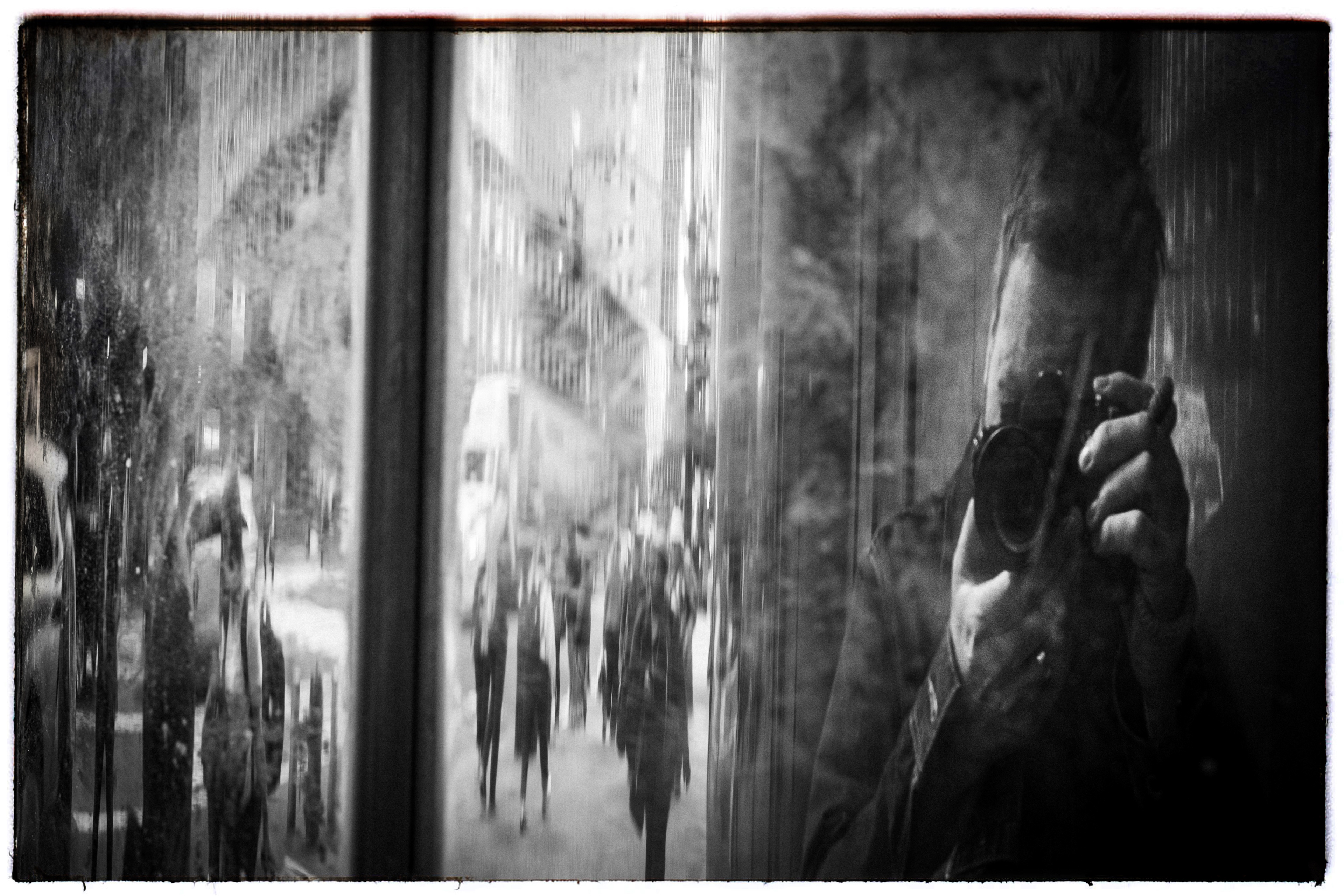
A good photograph beats death. A great photograph gives life. Think of William Klein, of Saul Leiter, of Robert Herman — photographers in the business of freezing time, of capturing the strangeness of being alive, the singularity of playing a part in the grand human experience. Now think of DL Burdon, a street photographer casting strangers in moving, surprising portraits. Burdon’s preference for abstraction — without sacrificing verisimilitude — is something of a fingerprint. A man appears, beautiful, ghostly, in the reflected glass of a window through which Burdon’s main subject is found. A woman, who spots his camera? Is it a picture of the man? The woman? In another photo, another woman stands, reflected in the glass of a storefront, and she holds an iPhone, as if taking a photo. Is she taking a picture of herself, of Burdon, or the small family that appears in the reflection, beside her? Or are they beyond the glass? Is it a picture of her? Of the family? Of course, it is of both and neither. Inevitably, these are portraits of a city, and its people, and the anonymity and solitude the city provides. Burdon’s light lines, and architectural sensibility, his brilliant eye for what is most affecting among us forms an essential aesthetic, one that matches the beautiful experiment of New York and its side-players, the day workers, the street walkers, the tossed aside, the drinkers, the eaters, the timeless crags in the faces of the hard, and the innocence in the eyes of the somehow still soft. These are great photographs of life, as it is lived, ultimately alone, on the fringes, in traffic, stepping off curbs, and beyond the borders of their composition, commingling with our very own souls.
Scott Cheshire, NYC, '26